

By: Kgothatso Moeti
What began as a bitter personal exchange on X has developed into a politically charged public controversy involving Economic Freedom Fighters leader Julius Malema, media personality Lebo Keswa and EFF MP Sixolise Gcilishe. The dispute has moved well beyond personal insult and counter-insult. It now raises broader questions about political confidentiality, leadership culture, internal party tensions and the dangers that arise when private relationships intersect with political proximity.
The visible sequence of events on X appears to have begun when Sixolise Gcilishe posted a message advising someone to leave a person who was allegedly helping them do questionable things. Lebo Keswa then responded sharply, effectively arguing that Gcilishe was in no position to offer relationship advice. From there, the exchange escalated rapidly. Keswa published a series of highly personal posts directed at Gcilishe and then drew Julius Malema directly into the dispute.
That moment changed the character of the controversy. Once Malema was publicly named, the matter ceased to be only a personal fallout between two individuals. It became a broader public and political issue because the allegations, whether ultimately true or false, touched on the conduct of a major political leader and invited public scrutiny of the internal culture of one of South Africa’s most prominent political parties.
What makes the exchange especially significant is the political implication embedded in Keswa’s posts. She presents herself not merely as someone lashing out emotionally, but as a person who claims to have been close enough to Gcilishe, during a romantic relationship, to hear private accounts and politically sensitive grievances. On that version of events, the dispute raises a serious public-interest concern. If a person in an intimate relationship with someone close to political power is hearing sensitive information about internal political matters, then the fallout from that relationship may no longer be simply private. It may carry consequences for public understanding of party dynamics, leadership conduct and internal trust.
That is where the issue becomes larger than scandal. Political organisations depend on discipline, loyalty, discretion and controlled communication. But when private relationships overlap with political influence, confidential conversations can quickly become public ammunition once trust collapses. Keswa’s posts suggest exactly that possibility. Her claims imply that what was once shared in confidence inside a romantic relationship has now entered the public domain in the middle of a deeply acrimonious fallout.
The controversy becomes even more politically charged because Keswa’s posts do not stop at personal grievance. They invite the public to connect her allegations to wider concerns about Julius Malema’s leadership style and treatment of people around him. More significantly, her comments have fueled speculation about whether the dispute sheds any light on longstanding questions around tension inside the EFF, including the departure of senior figures such as Floyd Shivambu and Mbuyiseni Ndlozi. That does not establish any factual explanation for those departures. No responsible article should present that as proven. But it is entirely fair to say that the exchange has reignited speculation about internal party culture and whether discontent around leadership may run deeper than has publicly been acknowledged.
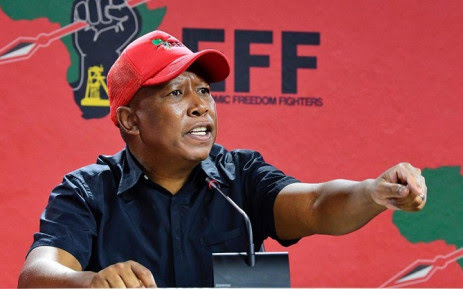
Malema’s own decision to intervene publicly gave the matter even greater significance. He first posted that he did not understand what was being said and asked for clarity before he would respond comprehensively. Keswa then replied directly to him, claiming that she had previously done communications and ghostwriting work involving him and Fikile Mbalula, allegedly commissioned by Sello Rasethaba during an earlier political period. Malema later responded in blunt terms, denying that she had written for him and rejecting the alleged role of Rasethaba in his life.
His intervention matters politically. It does not prove the substance of the allegations made against him. It does not confirm the broader narrative Keswa is attempting to build. But it does show that he considered the matter serious enough to answer publicly. That alone elevated the issue. Once Malema entered the exchange himself, it became more than social-media noise. It became part of a wider public conversation about power, leadership image, political vulnerability and reputational risk.
At the same time, the public nature of his response means the exchange will be interpreted politically whether he intended that or not. A leader of Malema’s stature does not usually respond directly to every online provocation. His choice to do so here has inevitably encouraged public debate about why this particular dispute warranted his attention. In politics, response can sometimes carry as much meaning as silence. Even where a denial is categorical, the very act of engaging can intensify public curiosity and enlarge the controversy.
The dispute also underscores a deeper problem in contemporary politics: the collapse of boundaries between the personal and the political. In an earlier era, private romantic fallouts and party tensions may have remained separate spheres. Today, they can converge instantly in public. A personal relationship can become a route through which private grievances, allegations of mistreatment, claims of insider knowledge and political speculation are all released into the same arena at the same time. That is precisely why this X clash matters. It exposes how personal breakdown can mutate into political crisis when the people involved are connected, visible and influential.
There is also a broader question about leadership culture. Keswa’s posts have been read by many not simply as expressions of pain or anger, but as claims pointing toward a wider pattern of how Malema allegedly treats subordinates, colleagues and people within his orbit. Whether that interpretation is fair or not will depend on evidence beyond social media. But politically, the damage often begins long before evidence is tested. Once such claims enter public discourse, they shape perception, fuel debate and place pressure on institutions and leaders to answer questions that may previously have remained private.
That is why the importance of this controversy does not lie in treating every allegation as fact. It lies in recognising that the exchange has opened up a public conversation about intimacy, influence, trust, political communication and internal party culture. The allegations remain contested. Some have been explicitly denied by Malema. Others remain hanging in the public domain without systematic rebuttal or verification. But even where facts remain disputed, the political effect is already real.
The Malema-Keswa-Gcilishe clash therefore matters not only because prominent names are involved, but because it reflects a wider feature of South African political life in the digital era. Personal relationships can overlap with political networks. Private confidences can acquire public meaning. Online disputes can trigger fresh scrutiny of old political questions. And reputational crises can develop with astonishing speed when emotional fallout, insider claims and leadership politics collide in full public view.
In the end, this is not merely a story about a social-media fight. It is a story about the fragility of political image, the risks of blurred boundaries between personal intimacy and political access, and the way public narratives are now formed in real time through allegation, denial and speculation. Whether the controversy fades quickly or develops into something larger, it has already succeeded in doing one important thing: it has forced uncomfortable questions about trust, power and political culture into the open.