

By: Kagiso Nkomo
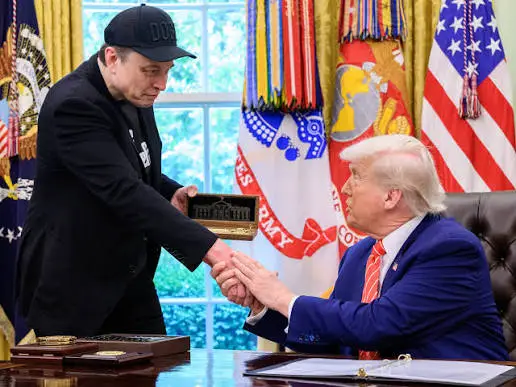
Donald Trump and Elon Musk have helped turn the false claim of “white genocide” in South Africa into an international political weapon. Far from being about human rights, the narrative serves a deeper agenda: pressuring Pretoria over sovereignty, strategic minerals, foreign policy independence and regulatory control in sectors such as land and telecoms.
Donald Trump has revived one of the most dishonest and politically useful myths in global discourse about South Africa: that the country is engaged in a campaign of “white genocide”. It is an inflammatory claim, long circulated in far-right media ecosystems, now repeated with renewed force by Trump-aligned voices in Washington and amplified by figures such as Elon Musk. It is also a claim that has been repeatedly rebutted by evidence.
Yet its persistence is not accidental. False narratives do not survive at this level because they are credible. They survive because they are useful. In this case, the fiction of a white population under racial extermination serves as a convenient moral cover for a deeper strategic agenda: to pressure South Africa into political alignment, weaken its sovereign policy choices, and increase foreign leverage over a country whose diplomatic independence and mineral wealth matter enormously in the new global contest for power.
This is why the issue should not be treated as merely another bizarre Trump obsession or social-media culture war. It is a geopolitical instrument. And South Africa would be dangerously naïve to think otherwise.
The debunked narrative – the facts versus the fiction
The first task is to state the facts plainly. South Africa has a violent crime crisis. Farm attacks occur. Farm murders occur. These crimes are serious and traumatic and deserve a full law-enforcement response. But they do not amount to genocide, nor do they provide evidence of a state-backed or racially coordinated extermination campaign against white people.
Official crime statistics, police briefings, agricultural bodies and independent analysts have consistently shown that farm murders form a very small fraction of South Africa’s overall homicide burden. More importantly, rural violence affects farm owners, workers, dwellers and families of different racial backgrounds. The victims are not exclusively white, and the perpetrators are not part of any proven racial extermination project. This is crime in a deeply violent society, not genocide.
The wider crime context matters. South Africa’s murder burden falls overwhelmingly on poor and working-class Black communities. Township residents, informal-settlement households, minibus operators, tavern-goers, schoolchildren and unemployed youth live with violence as a routine fact of daily life. That is where the centre of the country’s bloodshed lies. To elevate a small subset of rural killings into the defining moral story of South Africa while ignoring the mass victimisation of the Black majority is not objectivity. It is ideological selection.
The “white genocide” claim has therefore been debunked repeatedly, not only by the South African government and local fact-checkers, but also by researchers, policing experts and even conservative agricultural interests that take farm safety seriously but do not endorse the fiction of racial extermination. That should have ended the matter. It has not.
Why? Because the point was never accuracy.
America’s repeated interventions and statements
Washington’s interest in the story is not new, but under Trump it has become explicit, theatrical and deliberate. Trump has repeatedly invoked South Africa in racialised terms, presenting white South Africans as besieged victims of a black-majority democracy. His interventions have included tweets, public statements, executive posturing and repeated attempts to turn a fringe narrative into a respectable foreign-policy concern.
The pattern is familiar. A falsehood is lifted from extremist discourse, repackaged as a humanitarian concern, then circulated through sympathetic media networks and political allies until it becomes an acceptable talking point in mainstream power circles. Once that happens, the narrative can be used to justify pressure: diplomatic pressure, reputational pressure, trade pressure and investment pressure.
South Africa’s Expropriation Act, long distorted abroad as a vehicle for arbitrary land confiscation, has become one of the main hooks for this campaign. The reality is that the law operates within a constitutional framework and does not support the lurid image painted by Trumpist rhetoric. But the legal detail matters less to Washington’s narrative entrepreneurs than the political symbolism. Land reform, in their telling, becomes proof of anti-white hostility. Redress becomes persecution. Constitutional reform becomes civilisation under attack.
That is where Elon Musk enters the picture. Musk has increasingly echoed the same ideological frame, claiming South Africa has “racist laws” against white people. His language has not been accidental. It has dovetailed with the dispute over Starlink’s failure to secure market access in South Africa without complying with the country’s regulatory and empowerment requirements. In effect, a commercial and regulatory disagreement is being reframed as evidence of anti-white discrimination.
This is a deeply misleading argument. South Africa’s black economic empowerment framework emerged from a history in which the black majority was systematically excluded from ownership, control and participation in the economy. To describe redress measures in that context as equivalent to racial oppression of whites is not a serious legal or economic argument. It is a political weapon.
The socio-economic reality makes the claim even more cynical. White South Africans remain, on average, far better off than Black South Africans across income, wealth, asset ownership and access to opportunity. The racial structure of inequality in South Africa still reflects the material legacy of apartheid. To present whites as the primary victims of post-apartheid law while they remain the most economically advantaged racial group in the country is an inversion of reality.
That inversion, however, is politically useful to those who want to delegitimise transformation itself.
The real strategic and economic interests at stake
The deeper question is why Washington would invest so heavily in such an obviously weak narrative. The answer lies in South Africa’s strategic value and stubborn independence.
South Africa has refused to behave like a pliant subordinate of the West. It has maintained an independent foreign policy, participated actively in BRICS, preserved relations with Russia and China, resisted pressure to fall neatly into Western geopolitical blocs, and taken positions on Gaza and broader global governance issues that have irritated Washington. In an era of renewed great-power competition, this matters.
From the American perspective, South Africa is not just another middle-income democracy. It is a gateway economy on the African continent, an influential diplomatic actor in the Global South, and a country with substantial credibility in multilateral forums. Its refusal to align carries symbolic and practical consequences. That alone creates an incentive for pressure.
Then there is the mineral question, which may be even more important. South Africa holds some of the world’s most strategically significant mineral resources, including platinum group metals, chrome, manganese, vanadium, titanium, gold and other materials essential to manufacturing, defence systems, energy technologies and the global industrial transition. In a world where the United States is increasingly anxious about Chinese dominance over critical mineral supply chains, South Africa’s resource endowment becomes a matter of high strategic interest.
It is therefore difficult to ignore the alignment between the moral rhetoric and the material interests. A sovereign South Africa that sets its own terms on trade, energy partnerships, mineral development, industrial policy and foreign alignments is far less useful to Washington than a South Africa placed on the defensive, forced to spend its time rebutting moral accusations and protecting market access.
The “white genocide” narrative helps create that defensive terrain. It is not the end goal; it is the instrument.
Musk’s Starlink dispute fits neatly into this broader pattern. South Africa has insisted that companies operating in strategic sectors comply with domestic law, including transformation requirements. Musk and his allies have instead tried to cast that stance as anti-white racism. But the underlying issue is sovereignty. Who sets the rules for access to critical communications infrastructure in South Africa: the South African state, or politically powerful foreign billionaires backed by Washington’s ideological machinery?
This question is not trivial. Starlink is not an ordinary consumer product. It is a strategic communications platform with military, intelligence and geopolitical implications demonstrated in multiple conflict and security contexts abroad. That does not mean its operation in South Africa would automatically amount to espionage or foreign control. But it does mean any responsible sovereign state is entitled to interrogate the national-security implications of allowing foreign-controlled communications infrastructure to operate over its territory, shape connectivity patterns, and potentially become embedded in national systems.
The concern is not paranoia. It is prudence. Dependence on external digital infrastructure can create vulnerabilities in data governance, lawful interception, continuity of service, regulatory enforcement and geopolitical exposure. If such infrastructure is tied to actors who are already using political influence to attack South Africa’s domestic laws, the sovereignty question becomes even sharper.
Seen in that light, the campaign around “racist laws” is not just ideological posturing. It is a pressure tactic aimed at weakening the legitimacy of South Africa’s regulatory framework so that strategic concessions can be extracted more easily.
What this means for South African sovereignty and the economy
South Africa should understand the danger clearly. Once a false moral narrative takes hold internationally, it can be used to justify a much wider programme of coercion. Trade penalties can be rationalised. Aid pressure can be moralised. Investment uncertainty can be inflamed. Diplomatic isolation can be made to appear principled rather than strategic.
That is why the “white genocide” lie is not merely offensive. It is economically and politically dangerous.
It threatens investor confidence by portraying South Africa as unstable in a uniquely racial and civilisational sense. It invites foreign policymakers to treat domestic constitutional debates as evidence of illegitimacy. It creates cover for pressure on land reform, trade policy, energy choices and diplomatic alignments. And it seeks to turn South Africa’s sovereign insistence on transformation and policy autonomy into proof of extremism.
There is a hypocrisy at the centre of all this. The United States speaks the language of principle while pursuing leverage. It invokes human rights selectively, usually where they can be mobilised against states whose independence it finds inconvenient. South Africa is now being placed in that frame, not because the evidence supports it, but because the country’s sovereignty has become inconvenient.
The response should be calm, disciplined and united. South Africa must continue to rebut lies with facts. It must defend the legitimacy of constitutional redress. It must protect its right to regulate strategic sectors in the national interest. And it must recognise that disinformation is not only about reputation; it is often the opening move in a broader campaign to narrow a country’s room for sovereign action.
Trump’s obsession with South Africa is not about white lives. Musk’s rhetoric is not about civil rights. The real agenda is pressure: pressure to realign, pressure to concede, pressure to open strategic space on terms set elsewhere.
South Africans should reject that agenda for what it is. Whatever our domestic differences, the defence of national sovereignty cannot be outsourced and cannot be postponed. A country that overcame apartheid should not now allow itself to be morally blackmailed into submission by foreign interests dressing strategy up as conscience.
The lie must be confronted. The hypocrisy must be exposed. And South Africa, across race, class and party, must stand together in defence of its sovereignty.