

By: Kgothatso Moeti
The Western Cape has, for years, been regarded as the last unshaken stronghold of the Democratic Alliance. It has been a province defined by political consistency, where opposition fragmentation has historically ensured that no single challenger could mount a credible threat to the governing party. That reality, however, is beginning to change. A new political force is not only emerging, but organising itself with a level of discipline and strategic clarity rarely seen among smaller parties. The Patriotic Alliance, under the leadership of Gayton McKenzie, is steadily transforming itself from a peripheral player into a serious electoral contender.
This shift is not based on rhetoric. It is grounded in numbers, strategy, and an understanding of how power is actually won in a democratic system. In the 2024 elections, the Patriotic Alliance secured more than 140,000 votes in the Western Cape, amounting to approximately 7.5% of the provincial vote. This level of support is significant, particularly for a party that was, not long ago, considered marginal. It signals the emergence of a structured and expanding voter base rather than a temporary protest movement. In a political environment where many smaller parties generate attention but fail to convert it into sustained electoral growth, this trajectory places the PA in a different category altogether.
To fully understand the significance of this rise, one must examine the political terrain of the Western Cape. The province’s electoral outcomes have long been shaped by the voting patterns of the coloured community. This demographic has historically been decisive, yet often politically unsettled. Over time, large segments of this community consolidated behind the Democratic Alliance, which positioned itself as the most viable governing alternative. However, this support has not been immune to erosion. Persistent challenges such as crime, unemployment, social inequality, and perceptions of uneven service delivery have created dissatisfaction. In that space of dissatisfaction, the Patriotic Alliance has found opportunity.
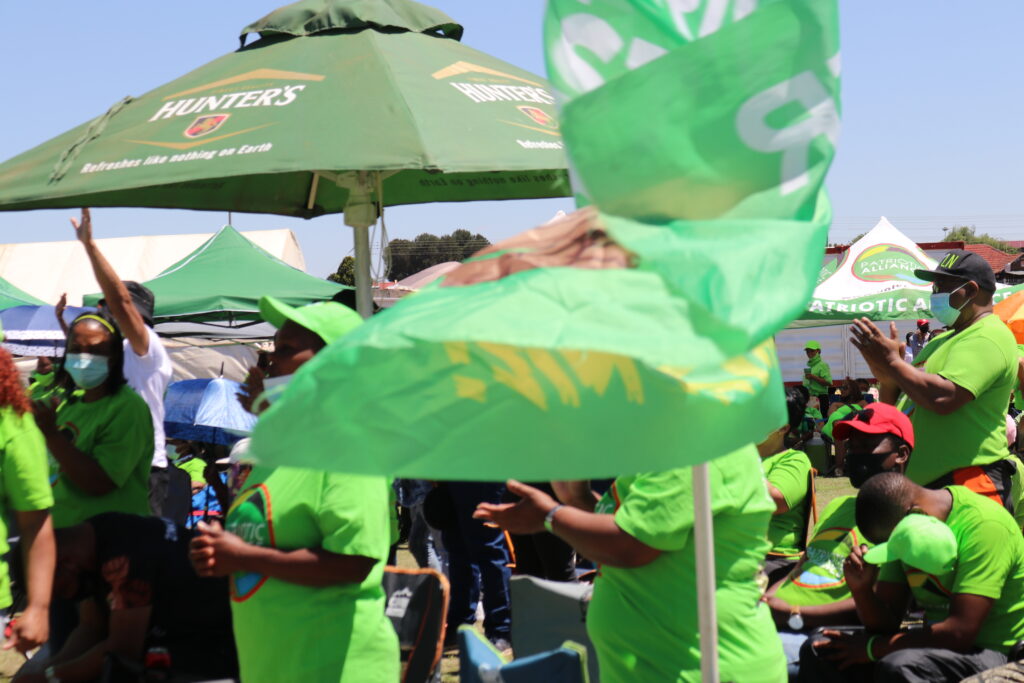
The PA’s approach to this electorate has not been abstract or distant. It has been grounded in proximity and lived experience. The party has embedded itself within communities, engaging directly with issues that affect daily life. It speaks in a language that resonates not because it is polished, but because it is familiar. This has allowed it to build trust in areas where traditional political messaging often fails to connect. Importantly, while the party’s base is strongly rooted within the coloured community, its strategy is not exclusionary. It consistently positions itself as a multiracial political formation, expanding its appeal across broader constituencies while maintaining the strength of its core support. This dual strategy, deepening a base while broadening reach, is a hallmark of successful electoral movements across the world.
What further distinguishes the Patriotic Alliance is its ideological and strategic clarity. It is not attempting to position itself as a revolutionary force. It is not seeking to dismantle the political system through disruption. Instead, it is building what can be described as an electoral movement. This distinction is critical. A revolutionary movement typically thrives on ideological mobilisation, confrontation, and systemic critique. It often generates visibility and emotional support, but struggles to translate that energy into governance outcomes. In contrast, an electoral movement focuses on winning power through democratic processes. It builds voter trust incrementally. It participates in institutions. It negotiates coalitions. It understands that legitimacy comes from ballots, not slogans.
The Patriotic Alliance has deliberately chosen this second path. It is not interested in being the loudest voice in the room. It is interested in becoming the most effective vote-earning machine. This is evident in its political strategy. The party invests heavily in ground-level campaigning. It prioritises direct engagement over distant communication. It maintains visibility in communities not only during election cycles, but consistently over time. Its leadership style reflects this approach. Gayton McKenzie is not a distant political figure. He is present, visible, and actively engaged in the environments where his support base lives and works.
This method of politics contrasts sharply with the approach of many smaller parties in South Africa. Numerous parties rely on ideological positioning, media statements, and national rhetoric. They seek to dominate conversations but often fail to dominate vote counts. Even prominent opposition parties such as the Economic Freedom Fighters, despite their strong national presence and ideological clarity, have encountered limitations in translating that visibility into sustained executive governance roles in key provinces. The Patriotic Alliance has taken a more pragmatic route. It focuses less on ideological dominance and more on electoral accumulation.
The party’s achievements reinforce this distinction. It has not remained confined to opposition benches. It has entered coalition governments at municipal level, demonstrating its ability to operate within governance structures. It has also participated in national governance arrangements following the 2024 elections, positioning itself within the broader framework of state power. This level of integration is significant. It reflects a party that understands that influence is not only exercised through opposition, but through participation.
Beyond formal governance, the PA has also demonstrated a capacity for direct community impact. Its origins include involvement in addressing issues such as gang violence and local instability. This problem-solving orientation differentiates it from parties that focus primarily on policy advocacy without direct engagement. It reinforces the perception that the party is not only interested in political positioning, but in tangible outcomes.
Its electoral growth further strengthens this perception. The party has not experienced a single spike followed by decline. Instead, it has shown consistent expansion. Its vote share has increased. Its geographic presence has broadened. Its relevance within coalition politics has deepened. This pattern suggests a long-term strategy aimed at sustained growth rather than short-term visibility.
The implications for the Western Cape are significant. The Democratic Alliance’s dominance has historically depended on a combination of consolidated voter support and fragmented opposition. The Patriotic Alliance challenges both conditions. It is reconfiguring a key voter base that has been central to the DA’s electoral success. It is also consolidating support within that base rather than fragmenting it further. In doing so, it introduces a level of competition that the province has not seen in years.
This does not mean that the DA’s position will collapse overnight. Political transitions of this nature are rarely immediate. However, it does indicate that the province is entering a period of realignment. Voter loyalties are shifting. New alliances are forming. The political landscape is becoming more fluid. In such an environment, disciplined and strategic parties have a distinct advantage.
The Patriotic Alliance appears to understand this moment. It is not attempting to disrupt the system from the outside. It is working methodically within the system to accumulate power. It recognises that elections are not won through noise, but through numbers. It builds those numbers through presence, engagement, and consistency.
Under the leadership of Gayton McKenzie, the party has embraced a model of politics that prioritises execution over rhetoric. It understands that communities respond to leaders who are present, not distant. It acknowledges that governance requires participation, not isolation. It is constructing an electoral machine designed not only to compete, but to win.
As the Western Cape approaches future local government elections, one reality is becoming increasingly clear. The political landscape is no longer fixed. The Patriotic Alliance is no longer a fringe voice. It is a growing force with a defined strategy, a consolidating base, and a clear understanding of how power is secured.
The path it has chosen is not revolutionary. It is electoral. It is deliberate. It is grounded in the mechanics of democracy. And if its current trajectory continues, the Western Cape may witness not a sudden upheaval, but a decisive shift driven not by ideology alone, but by a movement that understands that the ultimate currency of politics is the vote.
As the Western Cape approaches future local government elections, the political landscape is shifting. The question is no longer whether the Patriotic Alliance is relevant. The question is how far its momentum can carry it. In a democratic system, power ultimately rests on the ability to convert support into votes. The Patriotic Alliance has shown that it understands this principle. That understanding may prove to be its greatest strength.
The question is no longer whether the Patriotic Alliance is a factor, it is how far its momentum can carry it. And in a system where outcomes are determined by ballots, not narratives, the party’s strategy may prove decisive. If current trends continue, the Western Cape may witness a historic political shift not through revolution, but through the disciplined rise of an electoral movement that understands the mechanics of power. The message is simple: the path to victory is not noise, it is numbers. And the PA is building both.